Intelligent designAutomotive & MobilityAdvanced ManufacturingPublic Case
Correlation Baseline
13° physical impact test
Metric Definition
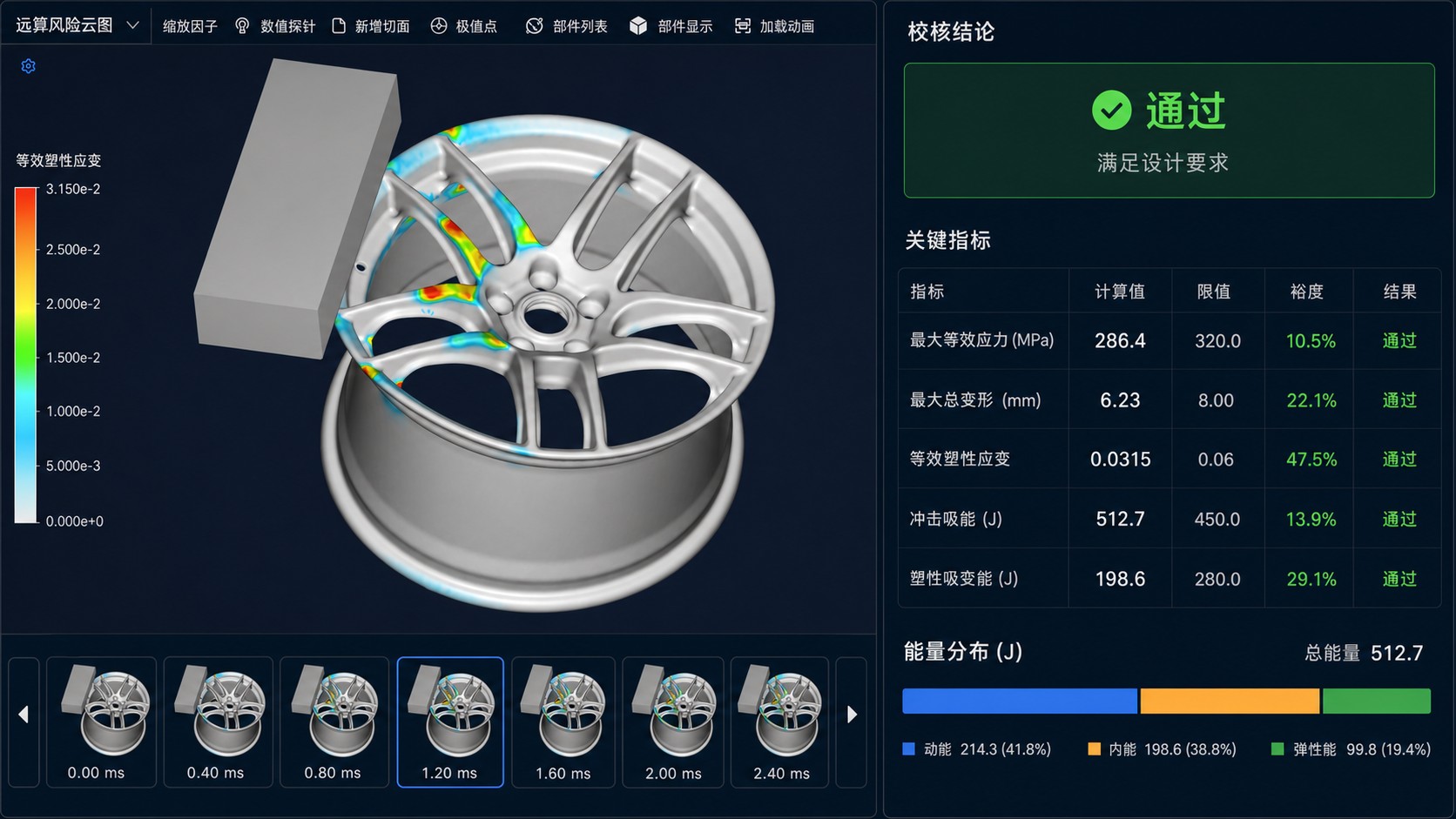
5/5 passed · 10.5% minimum margin
Simulation resultFour public validation artifacts
The engineering challenge
Wheel impact validation relies heavily on expert experience and physical testing, while physical-test and digital-validation correlation and reporting lack a shared standard.
How the engineering work changes
Previous approachApproach in this case
Manual expert steps
Template-driven Apps
Inconsistent reporting
Standard validation reports
01 / Engineering outcome
Key criteria passed
5/5
Smallest margin across all checks
10.5%
Published wheel-impact results · For this case’s conditions and assessment criteria
Correlate critical responses with the physical 13° impact test to support wheel-impact assessment.
Evidence and materials
The 13-degree physical impact test and agreed operating conditions form the correlation baseline.
Applicability
Published validation covers the 13° impact task. Strength, fatigue and other extensions need renewed checks of models, conditions and criteria.
Reusable engineering outputs
Impact-condition model
Simulation-test correlation
Standard validation report
02 / Materials
Representative Engineering Evidence
Simulation resultImpact Response ContourCritical responses and high-risk regions enter engineering review.
Published correlationSimulation-to-Test CorrelationResults, variances, and engineering judgment stay reviewable.
Report templateSample report layoutSample report template showing results, criteria and review records.
Interface illustrationEngineering App results view · IllustrationPackage validated methods and acceptance criteria in GEWU so teams can reuse them within their proven scope.
03 / Validation
Evidence and Validation Standard
Correlation Baseline · Metric Definition
Correlation Baseline
The 13-degree physical impact test and agreed operating conditions form the correlation baseline.
Metric Definition
Deformation, failure location, critical responses, and correlation deviation
Validation Method
Simulation-test correlation, engineering review, and a standard report close the acceptance loop.
Disclosure and Confidentiality
Response contours, correlation curves, the acceptance report, and the Engineering App are public; sensitive customer inputs remain private.
Implementation and reuse conditions
Solution Path
Simulation validation → Test review
From results to reusable capabilityProcess illustration
Validate the response
Correlate with physical tests
Engineering App
Capture inputs and criteria
Reuse on similar tasks
Run and review with templates
Conditions for further use
From the 13° impact task to strength, fatigue, and the broader wheel-validation workflow
Inputs for another use
Wheel geometry, materials and 13° impact conditions
Revalidation needed
Check models, criteria and applicability again when the object, conditions or codes change.